Bluh Velvet
Every July, Enrico Bartolini, the chef with more Michelin stars than anyone else in Italy, steps into the kitchen beside Vincenzo Russo, the young Campanian who won Bluh Furore its star within months of opening. The stage is Furore Grand Hotel, a 35-room retreat on the cliffs between Positano and Amalfi.
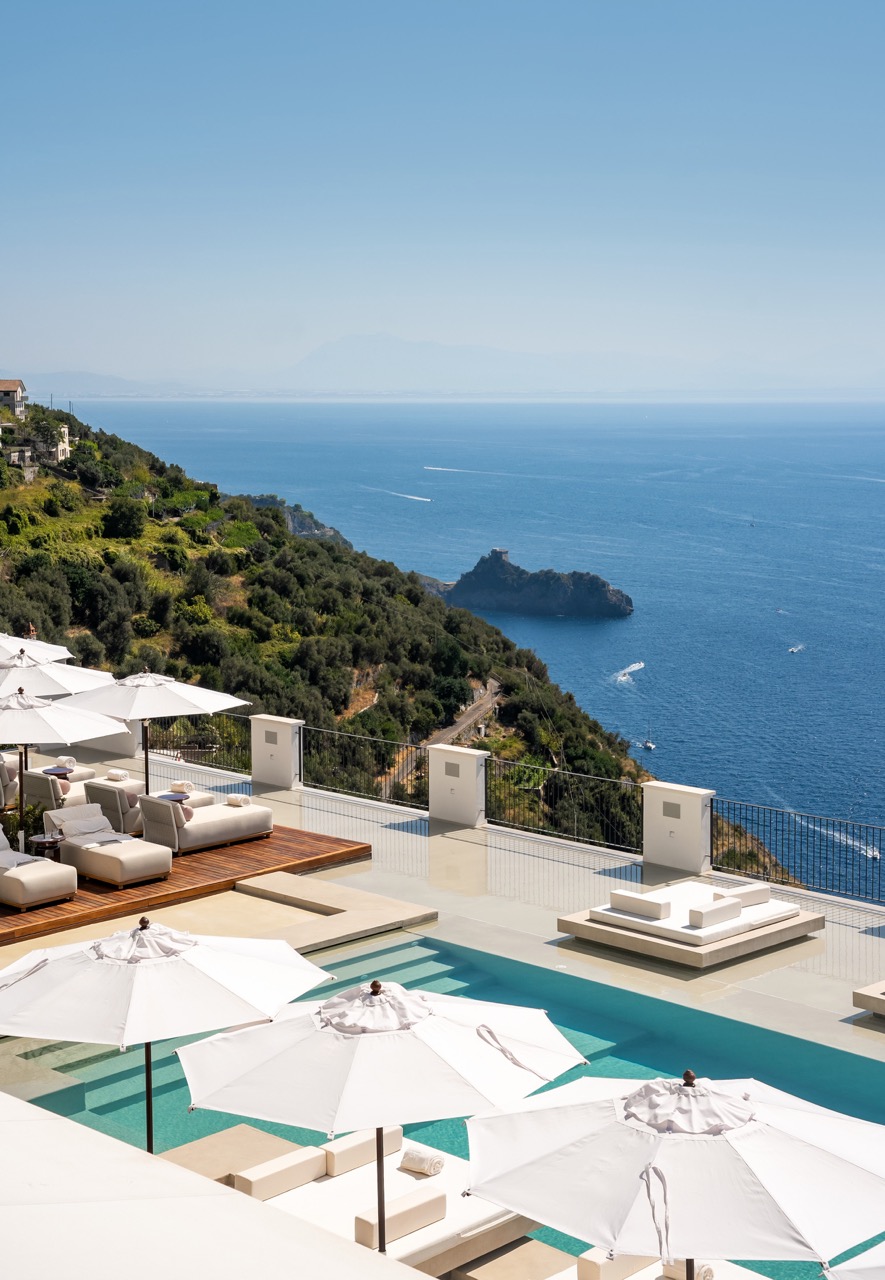
Furore Grand Hotel clings to the cliffs of the Amalfi Coast. Halfway down, between Positano and Amalfi, its terraces step towards the water, and from the terrace of Ria Lounge Bar there is nothing between you and the sea but a swimming pool. Below, the Tyrrhenian spreads out as far as you can see, turquoise where it touches the rocks, deepening to ink-blue further out until it melts into the sky. Around it, the mountainside is green with scrub and pine, broken by old stone terraces and small cultivated plots, with the coast road threading through. Somewhere beneath, out of sight, lies the Fiordo di Furore, a narrow gorge where a mountain stream meets the sea, crossed by a road bridge 30 metres up. It is one of the most photographed corners of the coast.
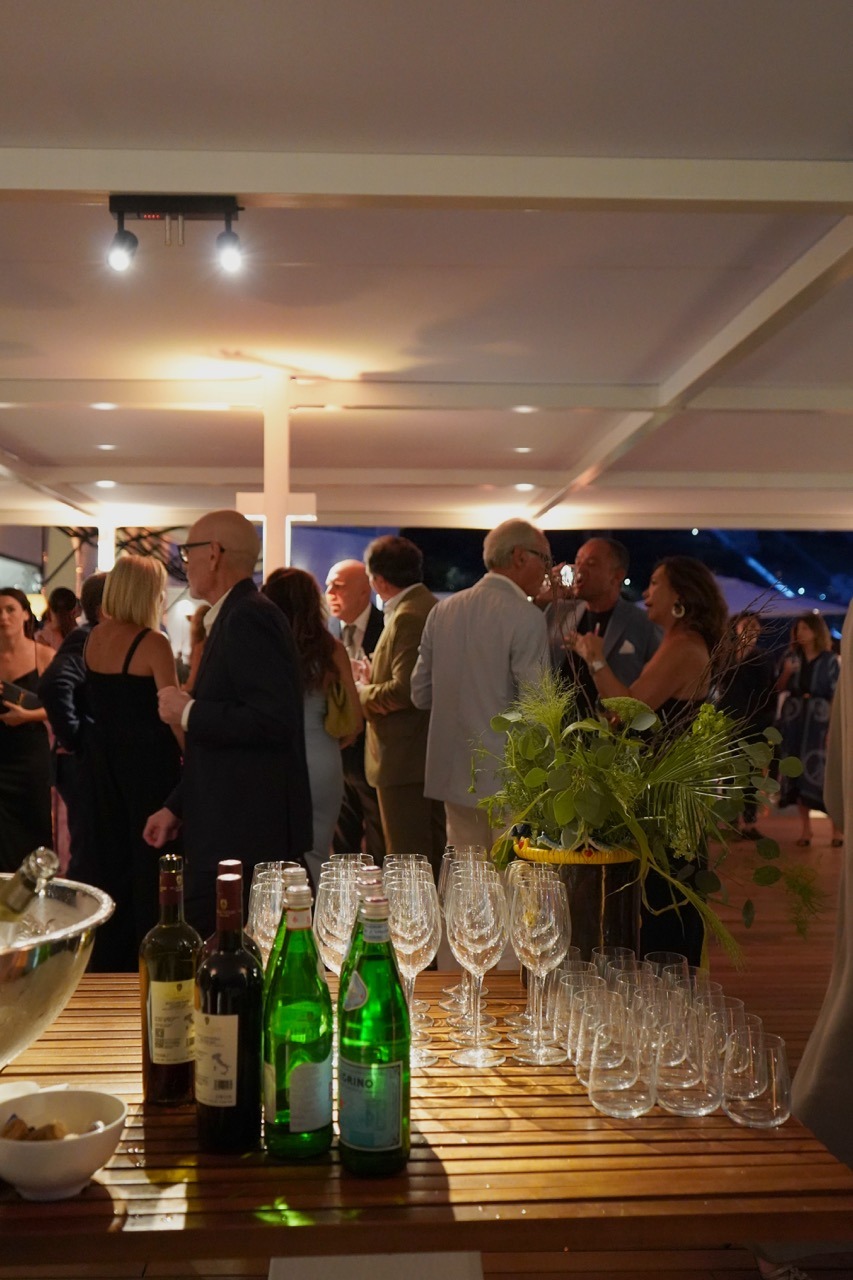
At half past seven on a Saturday in July, it is still fully light. The heat of the day has gone, a breeze comes off the water, and the sun, lower now, softens everything it touches. Guests arrive in linen suits and silk dresses: people staying at the hotel, others who have driven along the coast for the night, chefs and people from the trade. Each is handed a glass of Franciacorta and left to wander. In the glass was Ca' del Bosco's Cuvée Prestige. Franciacorta is Italy's answer to Champagne, made by the same method of second fermentation in the bottle, in the hills above Lake Iseo in Lombardy, and Ca' del Bosco is the house that did most to make its name. Since 2017, every release of the Cuvée Prestige has carried its edition number on the bottle; that evening's was Edizione 48. The mood is elegant and unhurried, growing livelier as more guests arrive.
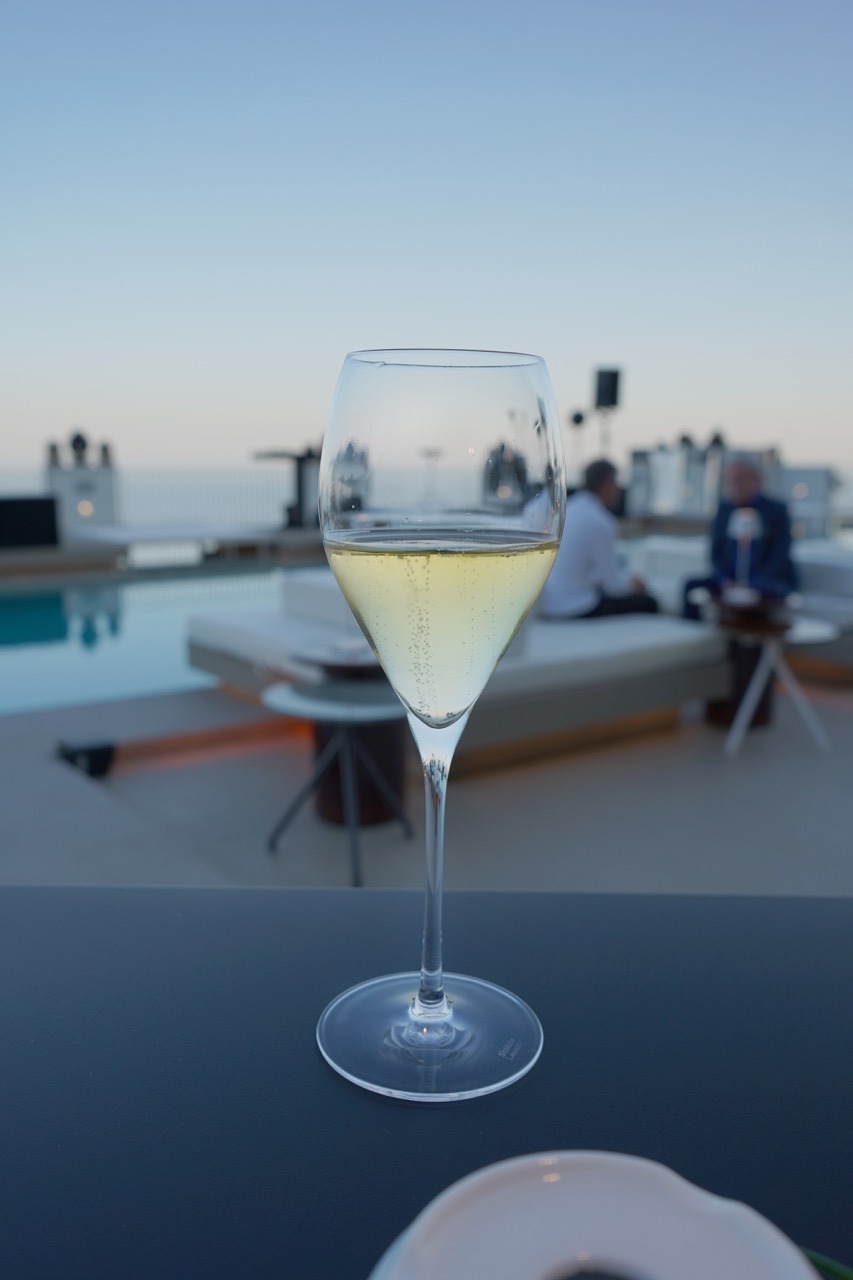
This is Bluh Velvet, the dinner show the hotel holds at this time every year. For this one night, Bartolini steps into the kitchen that Russo runs for the rest of the year. There is no seated dinner. Instead, the terraces are lined with live cooking stations, where chefs finish each dish one by one. Guests drift from station to station, glass in hand, and watch their food being finished in front of them. Think of it as a tasting menu you walk through. A DJ and live musicians play, and the party builds as the night goes on.
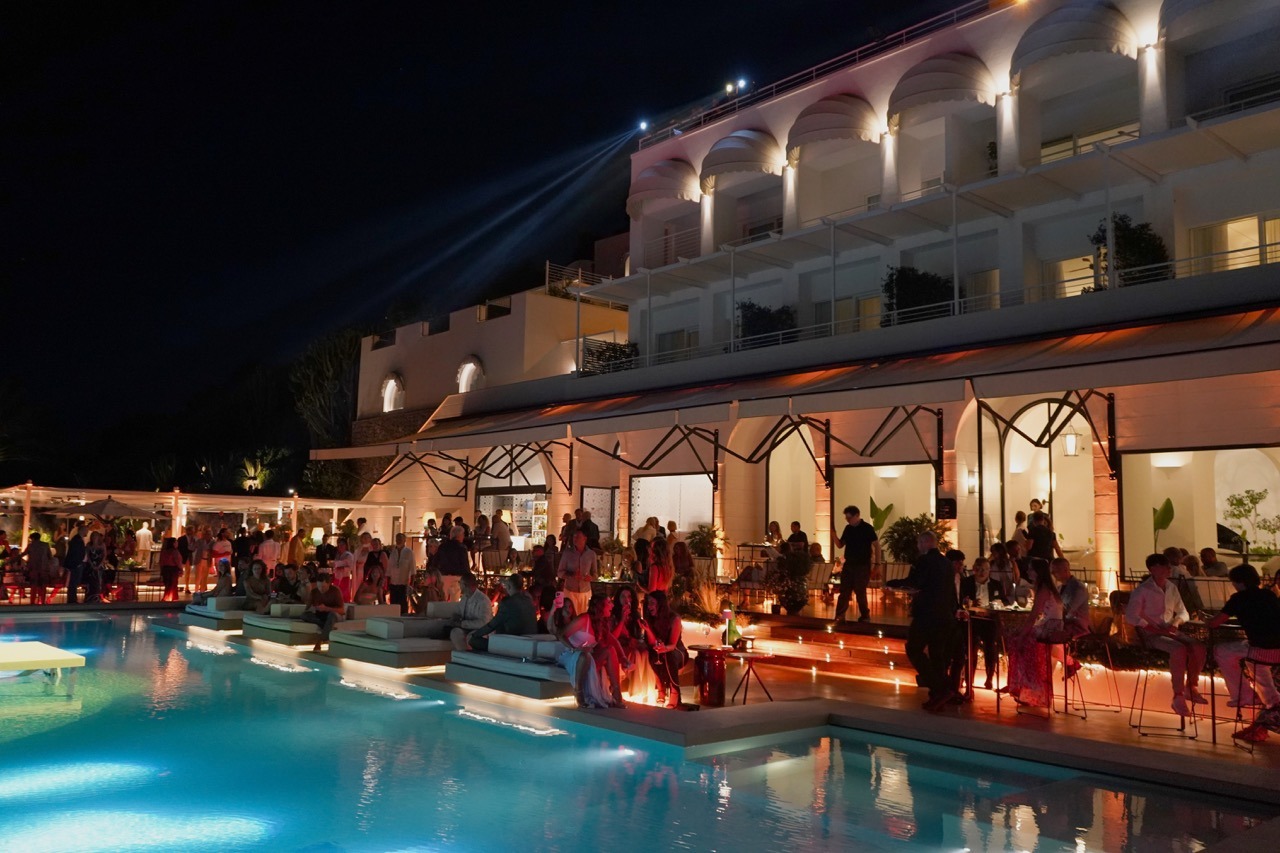
A new hotel from an Italian family
Furore Grand Hotel opened on this cliff in the summer of 2023, after a four-year project.
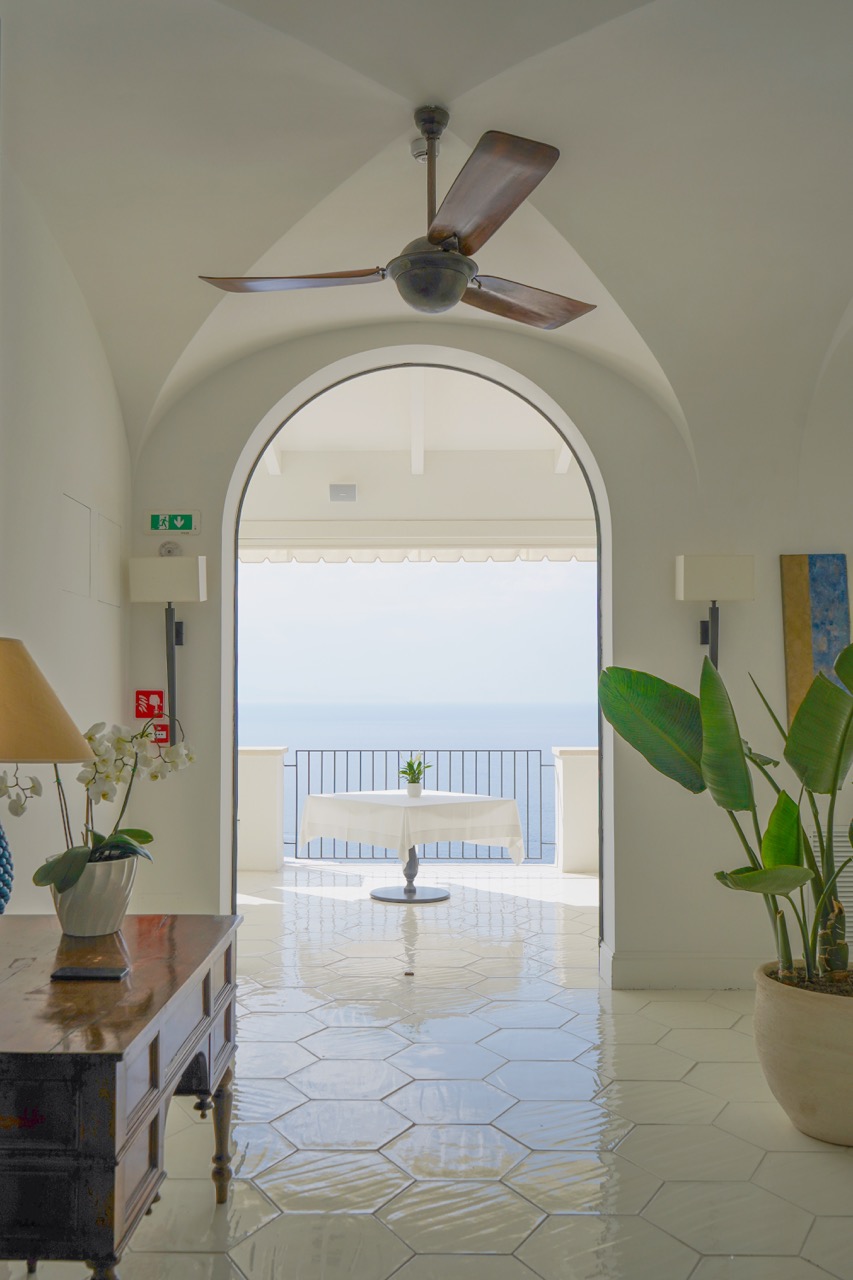
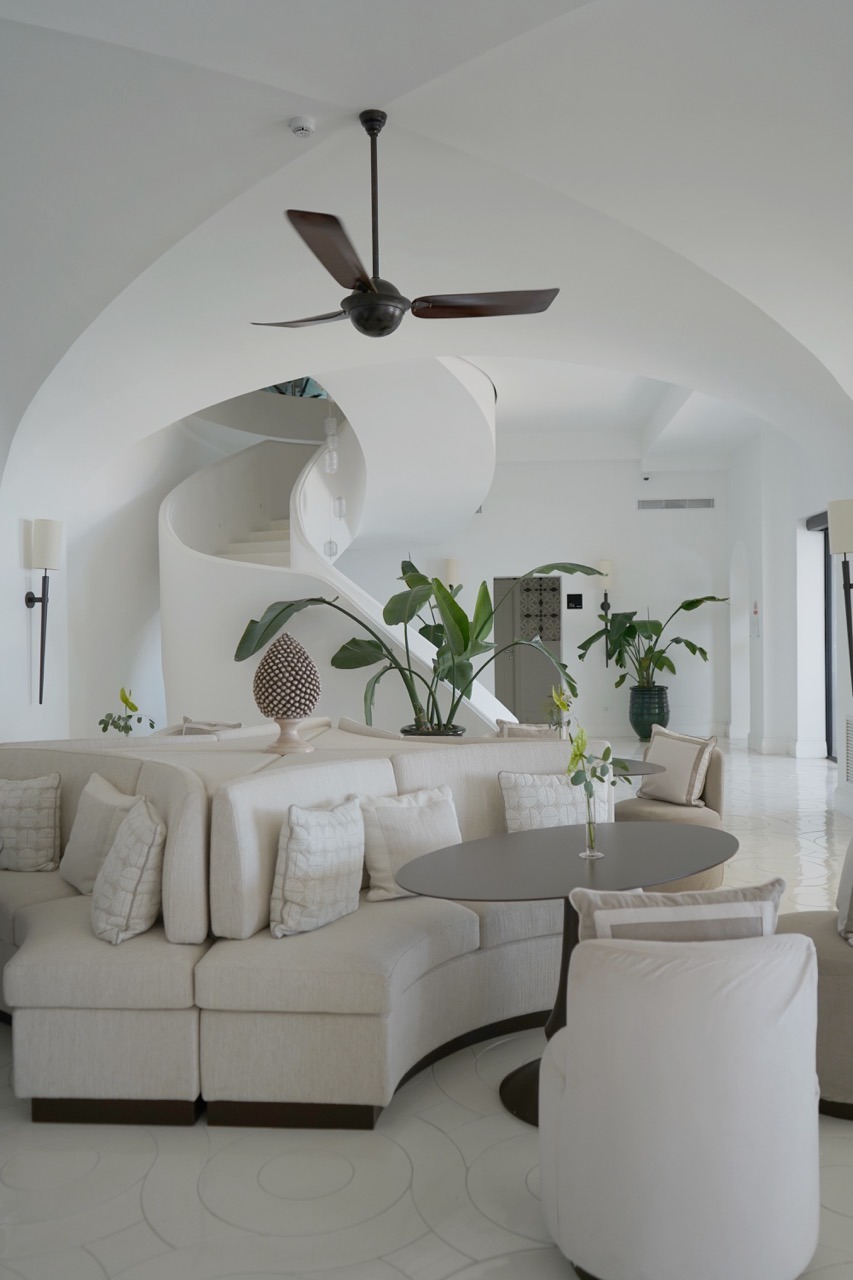
It feels like a spacious private villa above the sea. Walls, floors and linens are a crisp white, and the public spaces are clean and open. Arched doorways and walls trace soft curves, in a contemporary Mediterranean style. Owner Pietro Irollo de Lutiis has said he wanted the sea to be in view from anywhere in the hotel.
Pietro and his brothers, Giuliano and Alessandro Irollo de Lutiis, grew up in the trade. Their father bought Villa Romita on the Sorrentine Coast, which the family has run as La Medusa since 1974. The family also spent 25 years in travel: its tour operator, Gialpi Travel, had offices in New York, Rio de Janeiro, São Paulo and Tokyo.
The hotel spreads across nine levels of terraces and a park of more than 20,000 square metres, yet the building and its interiors were shaped by hand by local masons, carpenters, ceramicists and blacksmiths. Local farmers and the hotel's own kitchen garden supply the restaurants, and many of the staff are local.
The kitchen was at the heart of the plan from the start. The brothers asked Enrico Bartolini to oversee the hotel's food, and put a young Campanian chef, Vincenzo Russo, in charge of the kitchens. Within months of opening, the fine-dining restaurant, Bluh Furore, had a Michelin star. That kind of speed might be expected of a long-established house, but rarely of a hotel in its first season.
The chef who came home
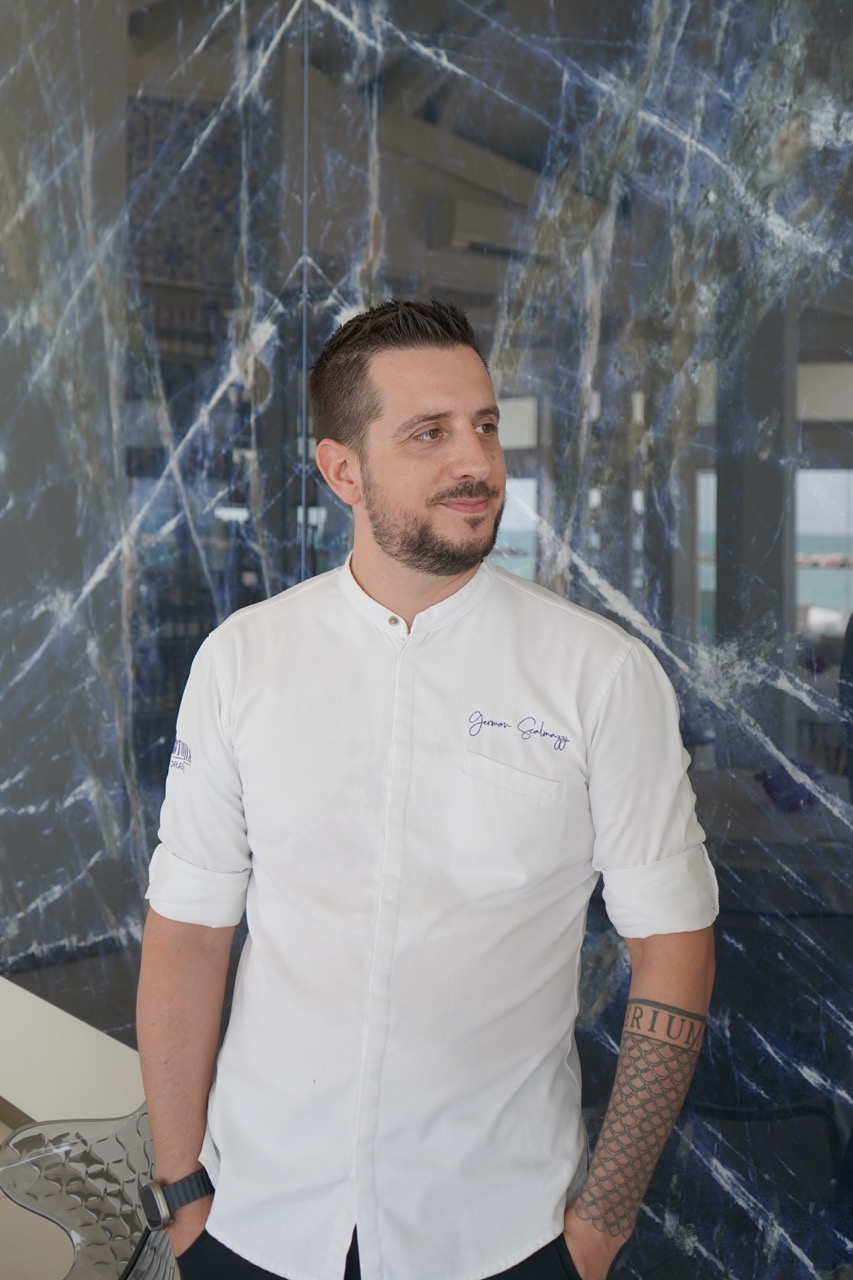
Vincenzo Russo was born in 1995 in Sant'Antonio Abate, at the foot of the Monti Lattari, the mountains that run down the spine of this peninsula. After hotel school, he spent seven years at Villa Crespi on Lake Orta under Antonino Cannavacciuolo, one of the best-known chefs in Italy. After time in Sardinia, he came back south in 2022, when the Irollo de Lutiis family asked him to run every kitchen at Furore.
That homecoming shapes his cooking. Russo works with small local producers and builds his menus around the memory of Campania. His signature Veli di Mare reworks pasta maritata, a traditional Campanian dish, with seafood, smoked mozzarella, escarole and colatura from nearby Cetara.
He runs the whole day, not just dinner. His team cooks for all three of the hotel's restaurants: Velaris, the panoramic terrace where breakfast is served; Acquarasa, the all-day restaurant for lunch and dinner; and Bluh Furore, the Michelin-starred fine-dining room. In October 2025, Food & Wine Italia named Russo its Best Chef Under 35.
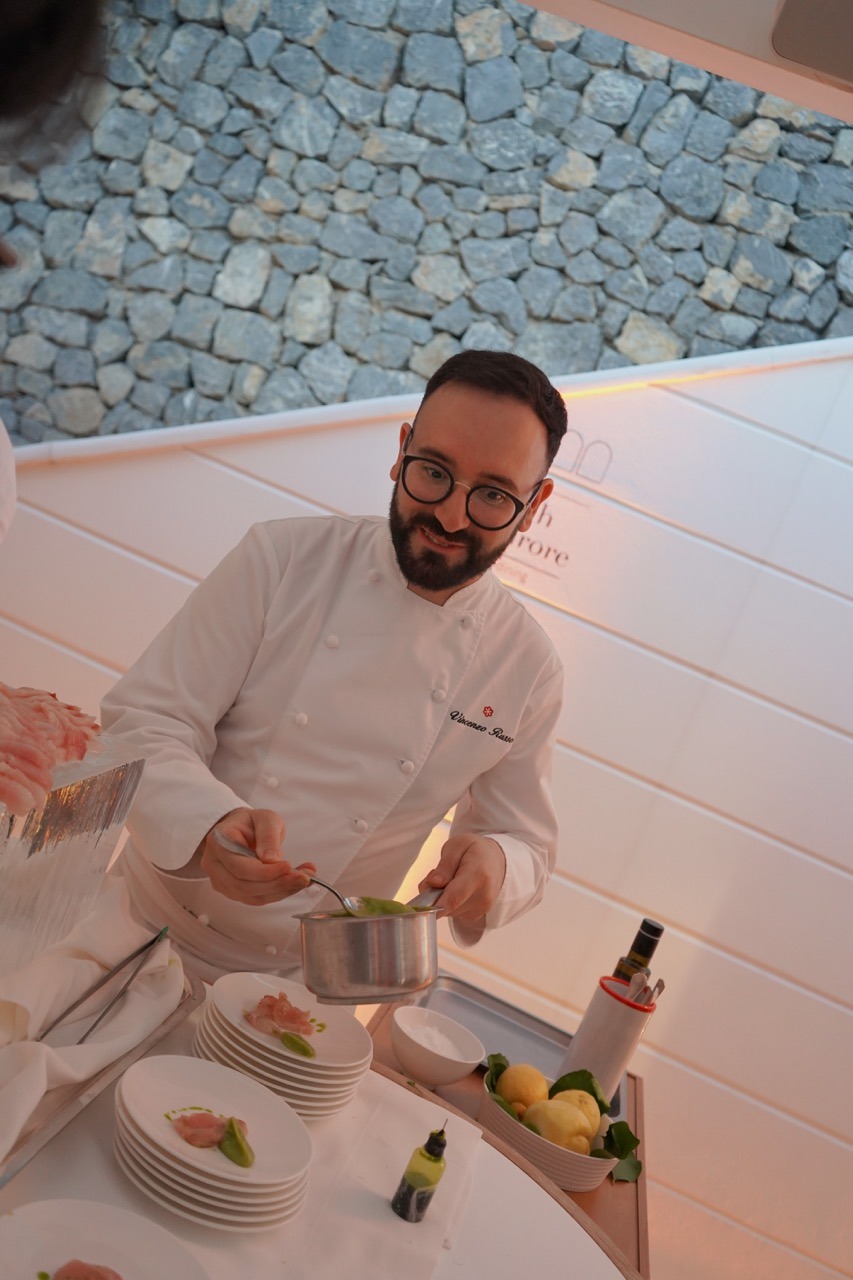
On the night of Bluh Velvet, Russo was everywhere. At one station he was slicing fish, each cut clean and graceful. Then he moved from station to station, keeping an eye on every plate his team sent out. As the time for the risotto drew near, he went back to the kitchen to finish it, while the live stations were cleared and reset for dessert. He was busy all evening, yet never looked rushed, with an eye on everything.
The mentor
Enrico Bartolini needs little introduction in Italy. Born in Tuscany in 1979, he holds more Michelin stars than any other Italian chef, fourteen across nine restaurants. They start in Milan, where his flagship at the Mudec museum has three stars, and spread across Italy, with more restaurants abroad. He is known as much for building teams as for his own cooking: in most of his restaurants, the stars are won by the chefs who work alongside him.
Bluh Furore serves a few of his signature dishes, but the daily cooking is Russo's, in what the hotel calls a constant dialogue between the two. Bluh Velvet is the one night a year when that dialogue happens in public, in the same kitchen.
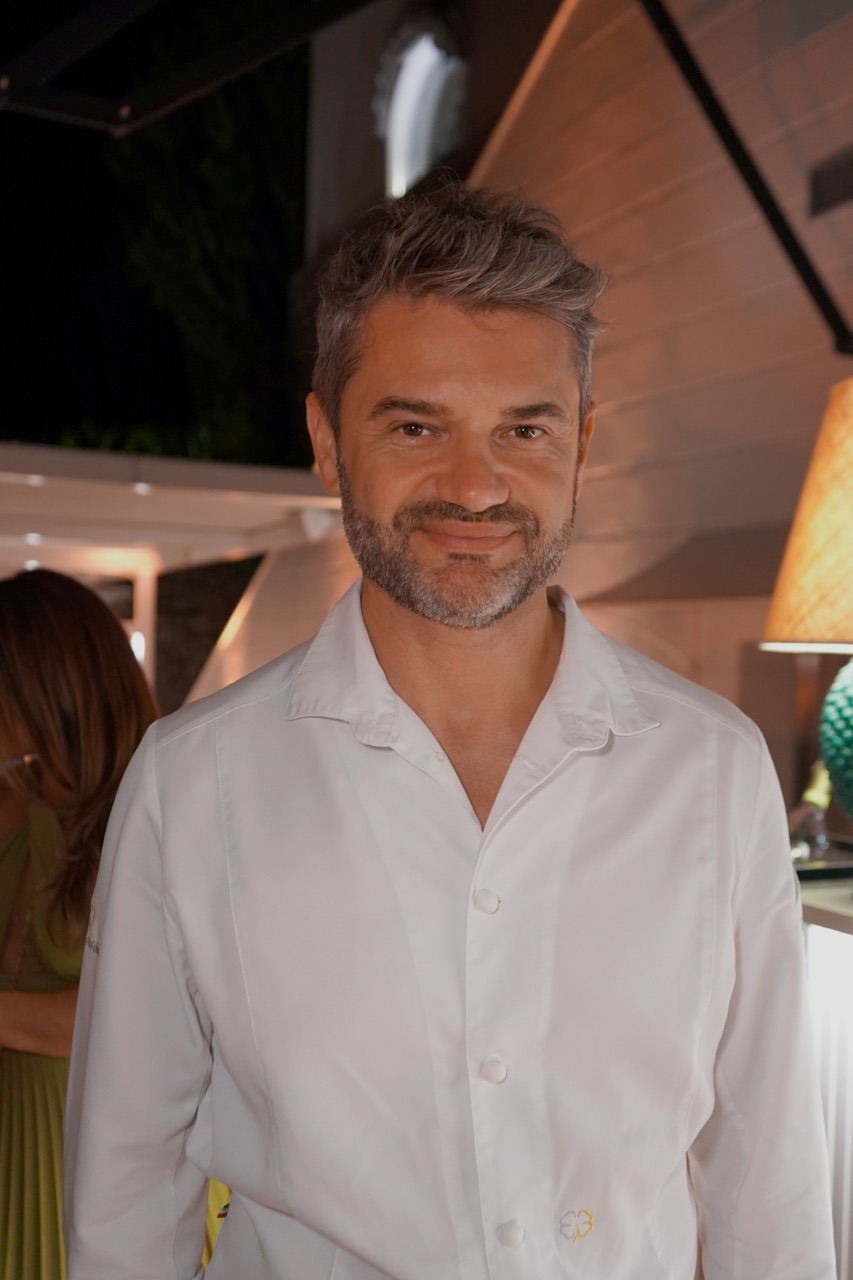
Bluh Velvet
Bluh Velvet is now in its second edition: a party with food at its centre, open to hotel guests and outside visitors alike.
The menu traced the memory of Campania, the region around Naples and the Amalfi Coast, while bringing in ideas Russo has picked up abroad.
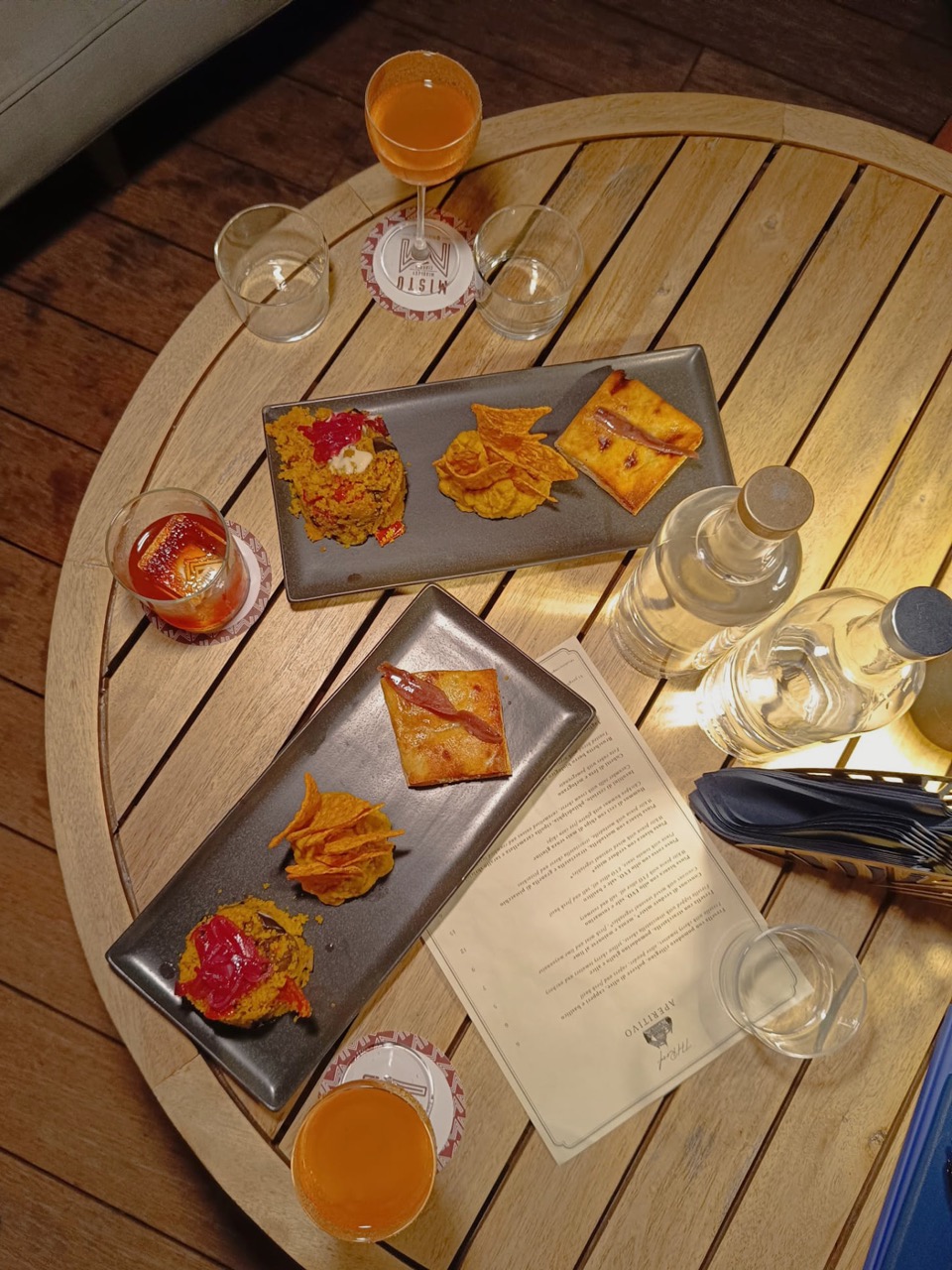
The evening began with the aperitivo at Ria Lounge Bar, where bite-sized starters were brought round to guests, glass in hand: a craquelé topped with caviar and gold leaf, Catalan-style lobster tacos, and fried gnocco made with grano arso, burnt wheat, served with smoked aubergine and tomato confit. Grano arso goes back to the poor farmers of southern Italy, who gleaned the wheat left in fields after they had been burned off after harvest, and ground it into a dark, toasty flour.
At the live cooking stations came oysters, sea bream with carrots and tagetes, the edible marigold, and sea bass with beetroot and yuzu. The Festival di Pomodoro paired seasonal tomatoes with flying squid, cooked shabu-shabu style. Octopus skewers were grilled in front of the guests on a Japanese yakitori grill and finished with a seafood barbecue sauce of peppers, tomato, ginger, lemon, sesame and colatura, the anchovy sauce long made in the fishing village of Cetara nearby, with a deep, savoury richness. Yuzu, shabu-shabu, a yakitori grill: the Japanese touches Russo has brought in sit lightly on these Campanian plates.
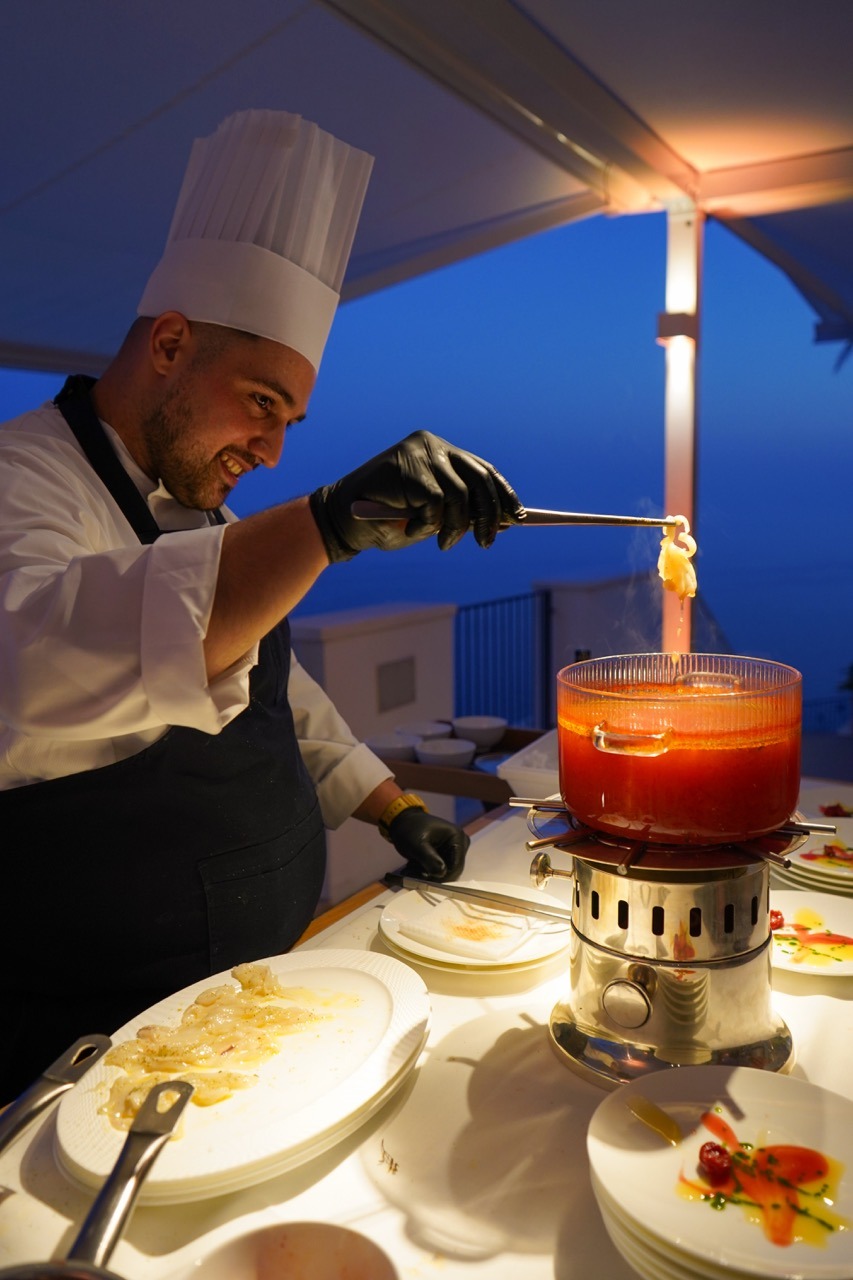
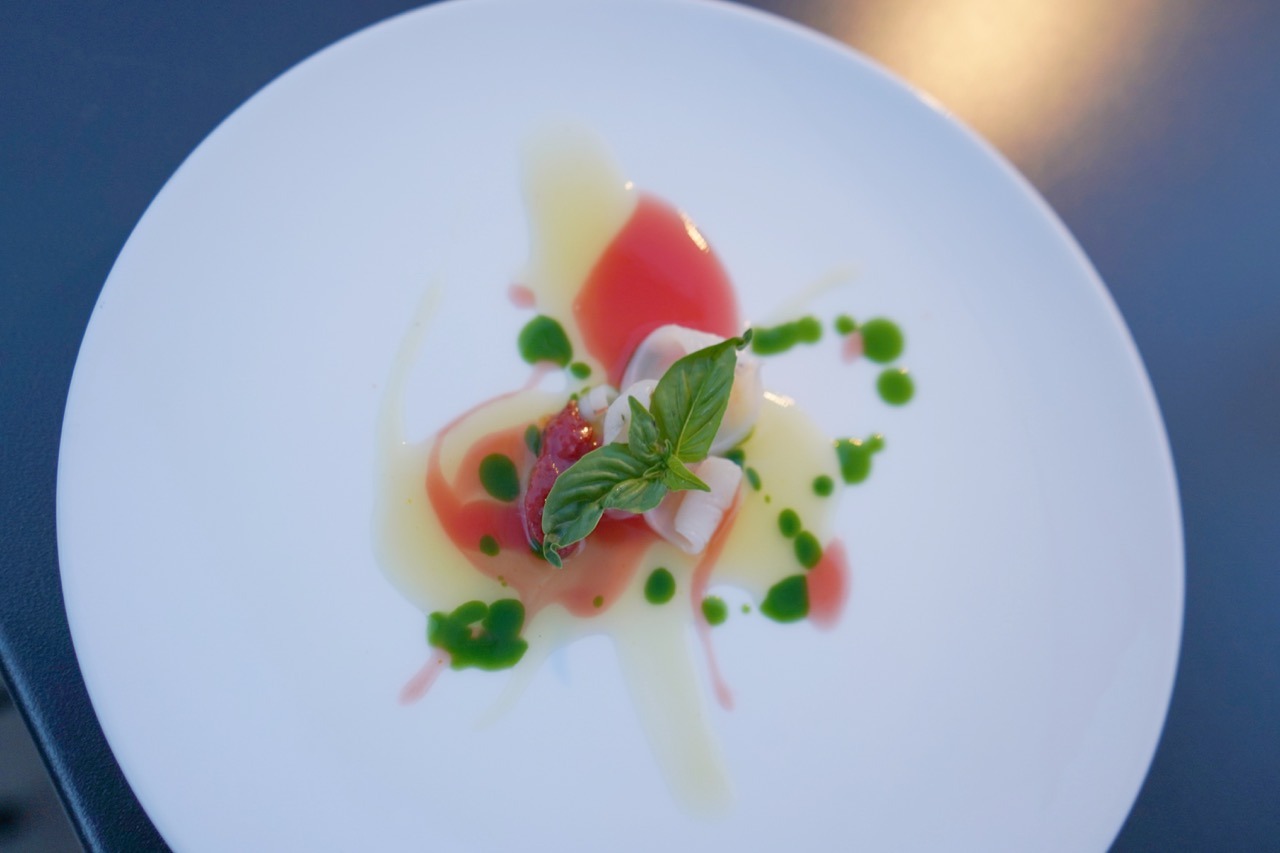
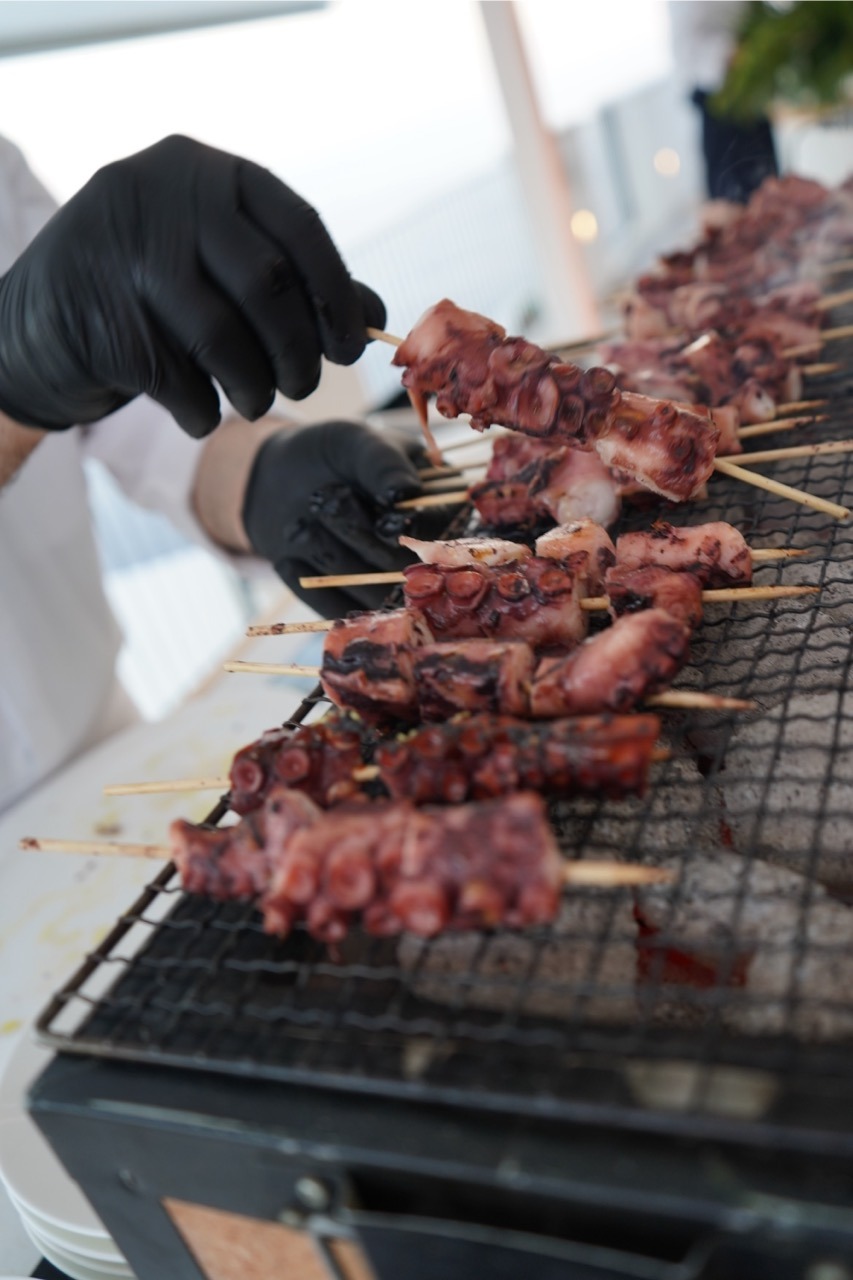
The classics of Neapolitan street food appeared too: fried pizza, and pizza a portafoglio, folded in four to be eaten by hand.
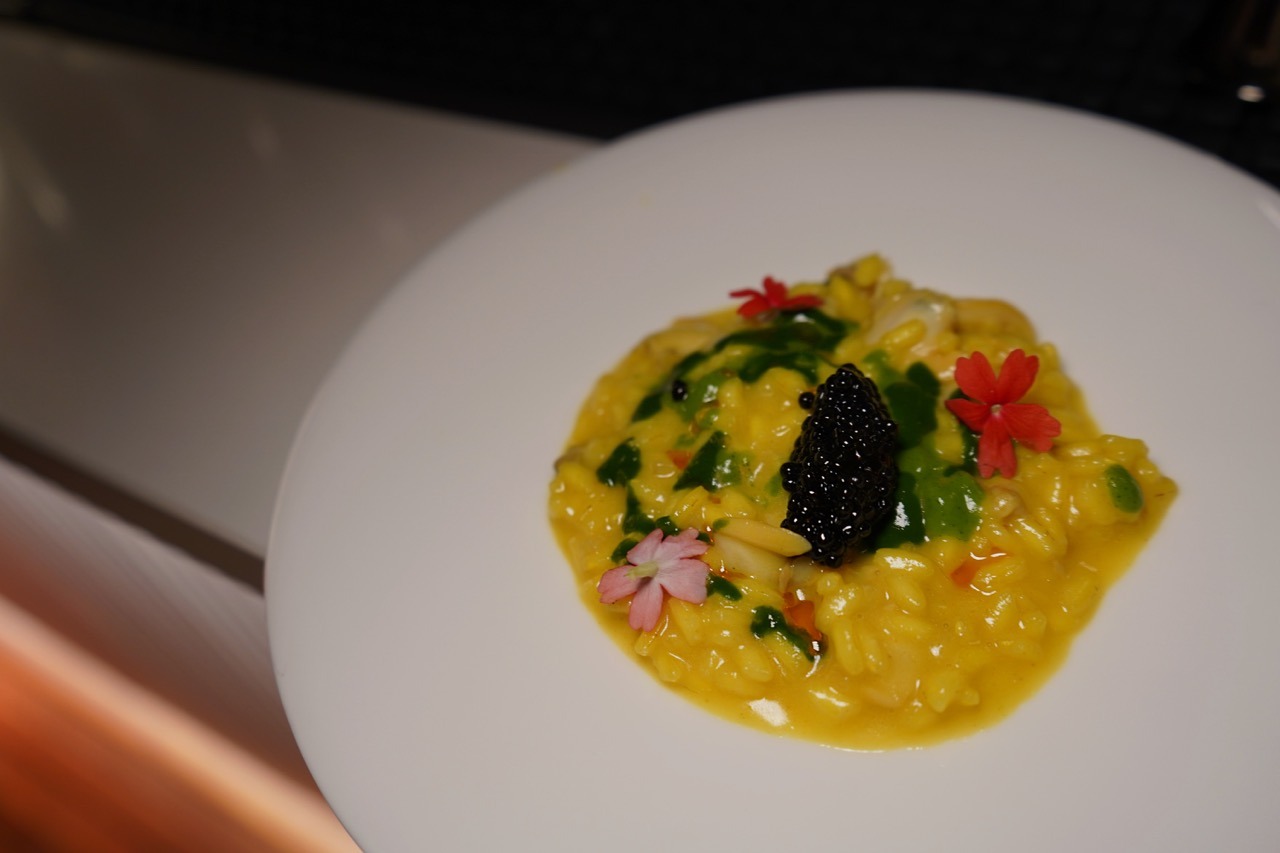
Risotto con Furore, created by the two chefs for the night, captured the warm yellow of the coast with yellow courgettes and turmeric, balanced by caviar and basil pesto.
Cuttlefish, seared on the spot, came with courgettes alla scapece, marinated in vinegar and mint, along with an almond sauce and a squid-ink sauce.
Once the stations were reset for dessert, the chefs finished each sweet to order: Caffè Corretto, a dessert built on the Italian habit of "correcting" an after-dinner espresso with a splash of liqueur; rhubarb with vanilla and tonka bean; an exotic raviolo; and an aubergine and chocolate tartlet. Aubergine and chocolate may sound unlikely, but on the Amalfi Coast it is a traditional summer sweet. There was also the sfogliatella Santa Rosa, the shell-shaped pastry said to have been created in the 18th century by the nuns of the Santa Rosa convent in nearby Conca dei Marini.
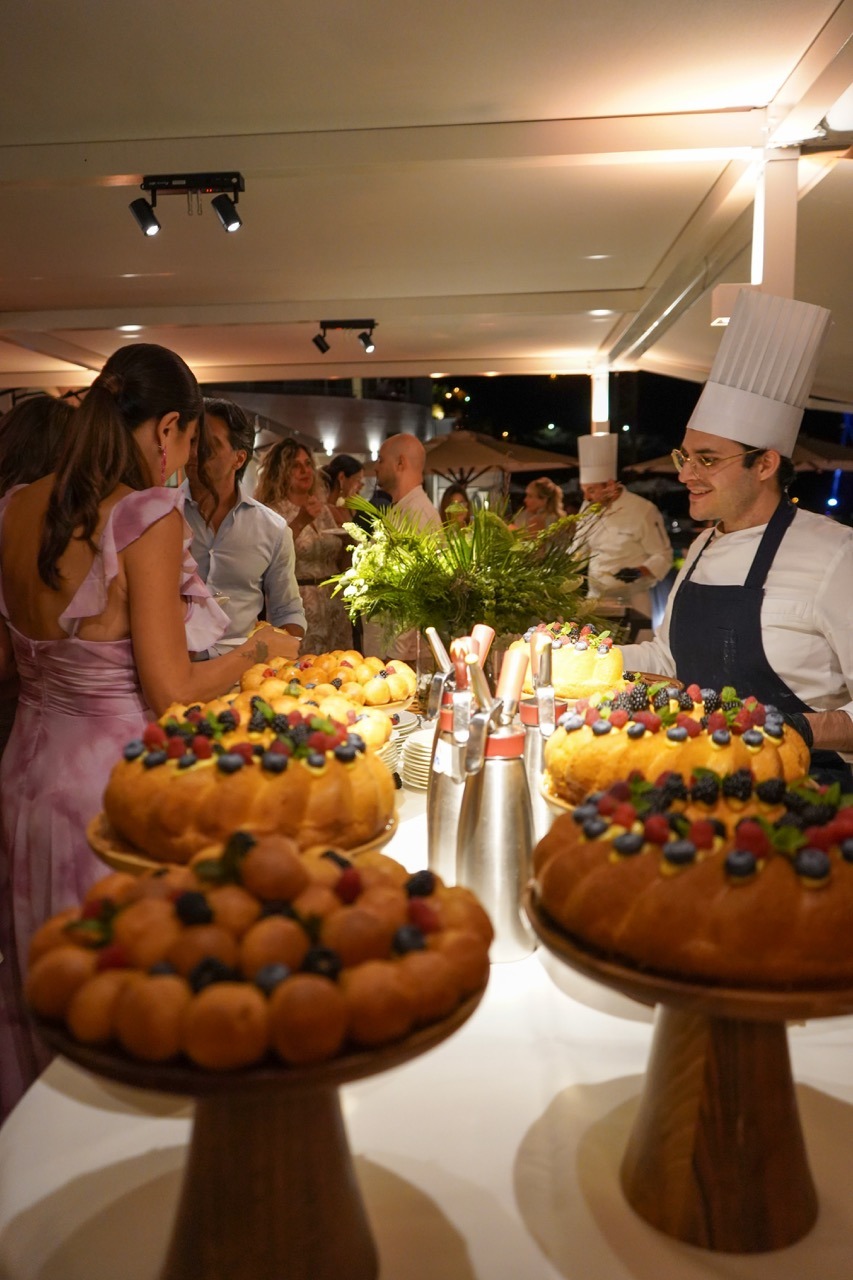
The petits fours that followed included a bombolone filled with limoncello cream, a delizia, sponge cake wrapped in Amalfi lemon cream, almond-and-lemon pastries and mille-feuille, while a grand babà savarin was cut in front of the guests.
The wines, chosen by the sommelier, followed the Ca' del Bosco with a white and a red from Campania. The white was a Falanghina from Contrada Michele in Irpinia, the region's inland wine country: Campania's signature white grape, fresh and made for seafood. The red was Villa Matilde's Stregamora, made from Piedirosso, a native Campanian grape whose name means "red foot", after its red stalks, said to resemble a pigeon's feet.
The morning after
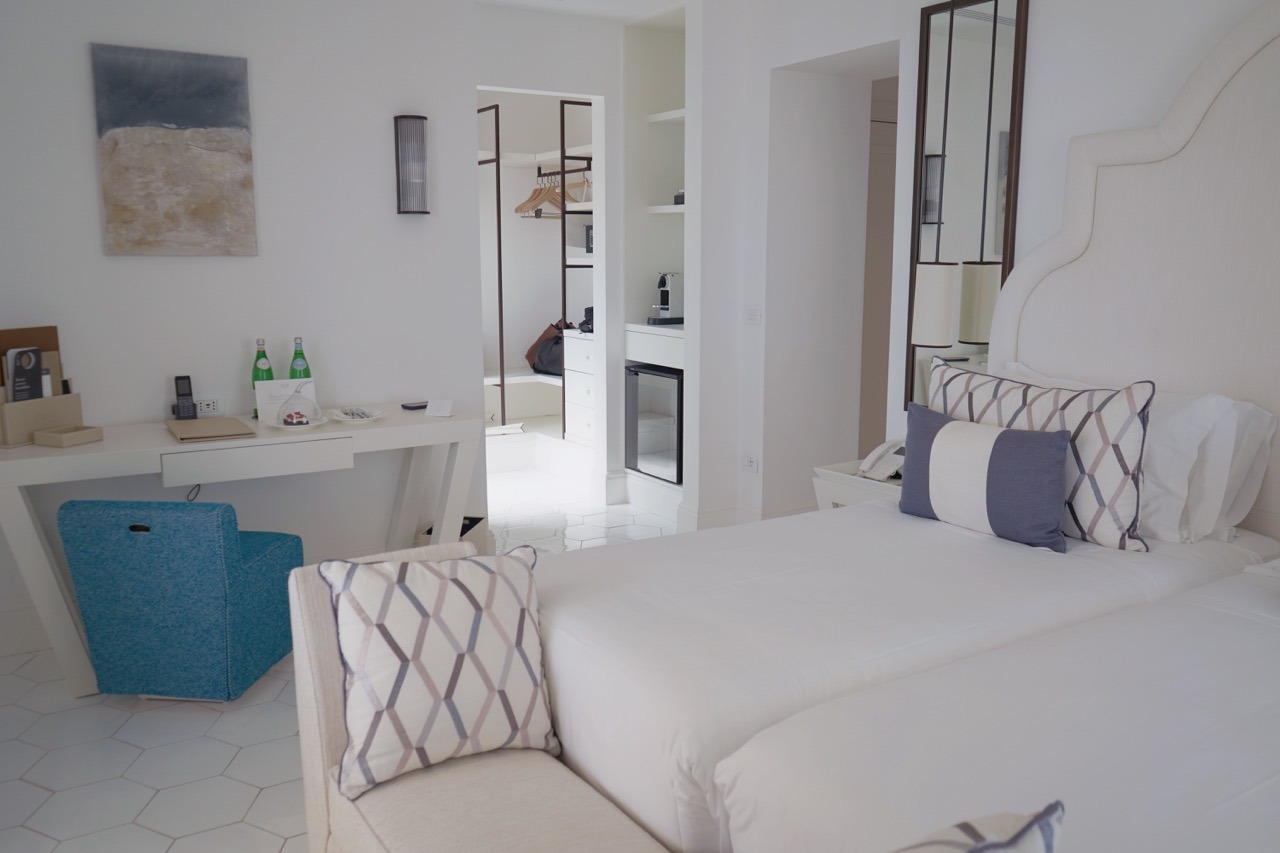
Rooms are done in an elegant, calm Mediterranean villa style: a white base warmed by natural materials and soft colours. From the bed or the terrace, the sea fills the view.
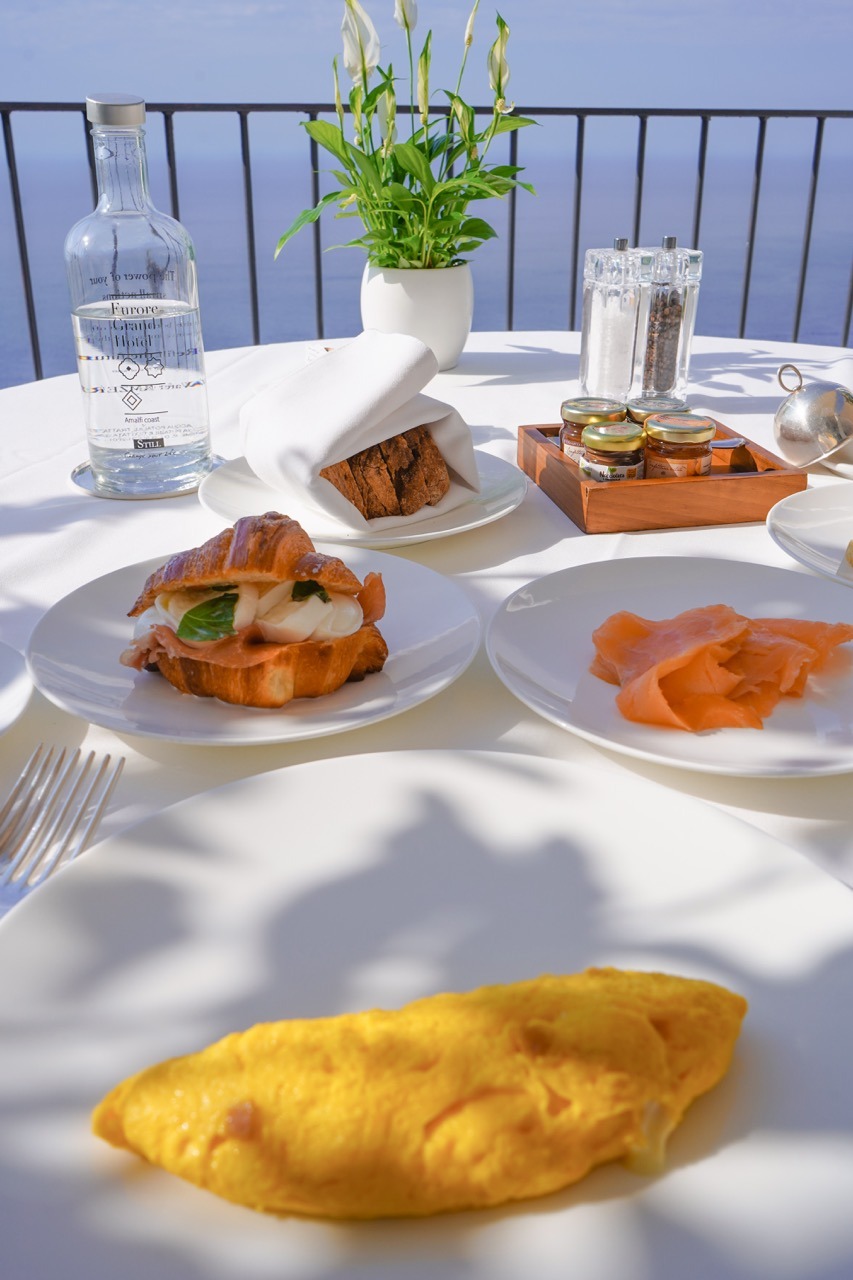
Breakfast is served at Velaris, on a terrace above the sea, and it comes with a small ritual: Neapolitan coffee brewed in a cuccumella and scented with zest from lemons grown on the property. The cuccumella is the old flip-over pot of Naples. Water is heated in the lower half, then the pot is turned upside down and the water drips slowly through the grounds. Neapolitans know it from Eduardo De Filippo's play Questi fantasmi!, in which the hero, out on his balcony, explains with great ceremony how to make coffee in one.
Eggs are cooked to order, alongside house pastries and an à la carte menu. But the one thing worth saving room for is the babà. Here it arrives as a large cake, soaked in rum and sliced to order. Babà is one of the great sweets of Naples, but it was born in France. The story goes that it was created in Lorraine, in what is now eastern France, for Stanisław Leszczyński, the exiled king of Poland, refined by pastry chefs in Paris, and carried to Naples by the French-trained cooks of aristocratic households, known locally as monsù. Naples never let it go. Even today, telling someone they are nu babà is a compliment: it means they are a delight.
By the pool, in the spa
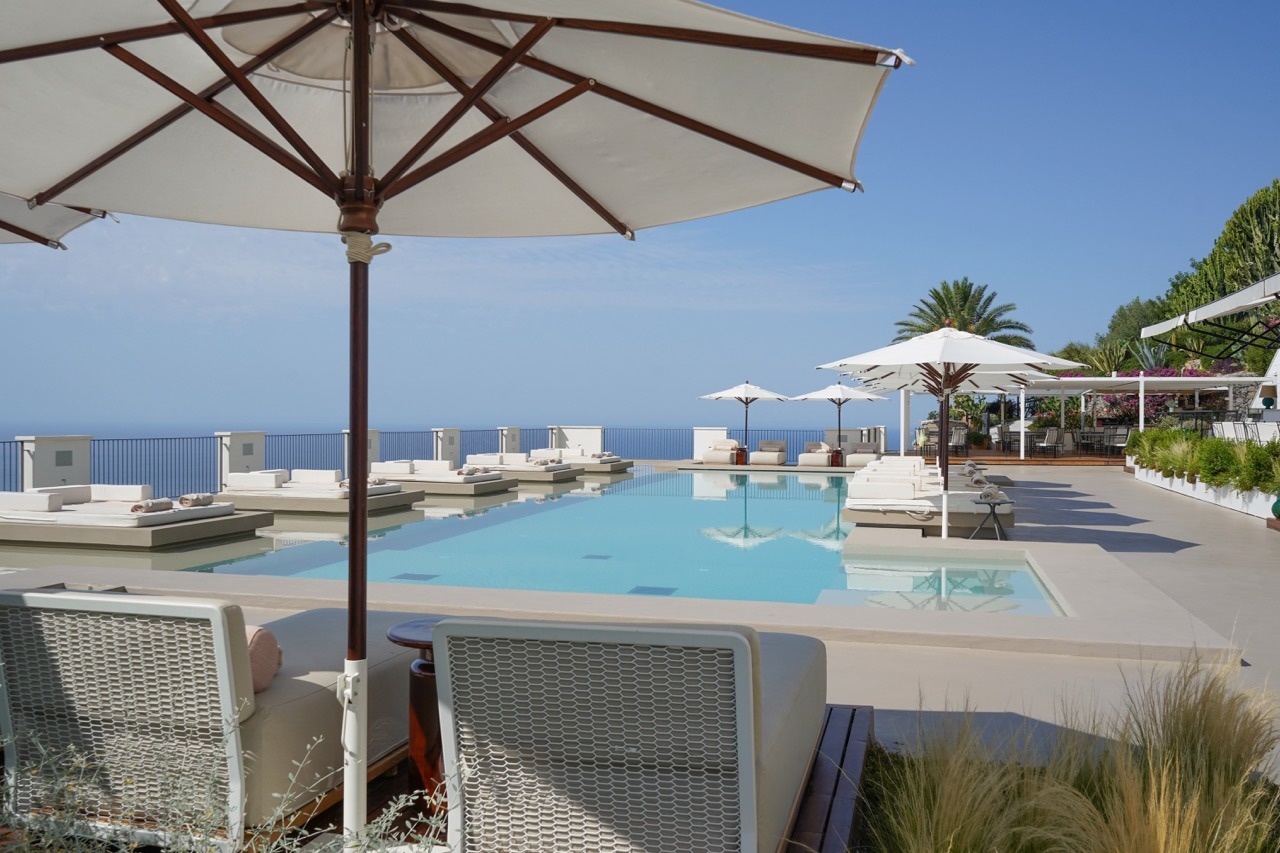
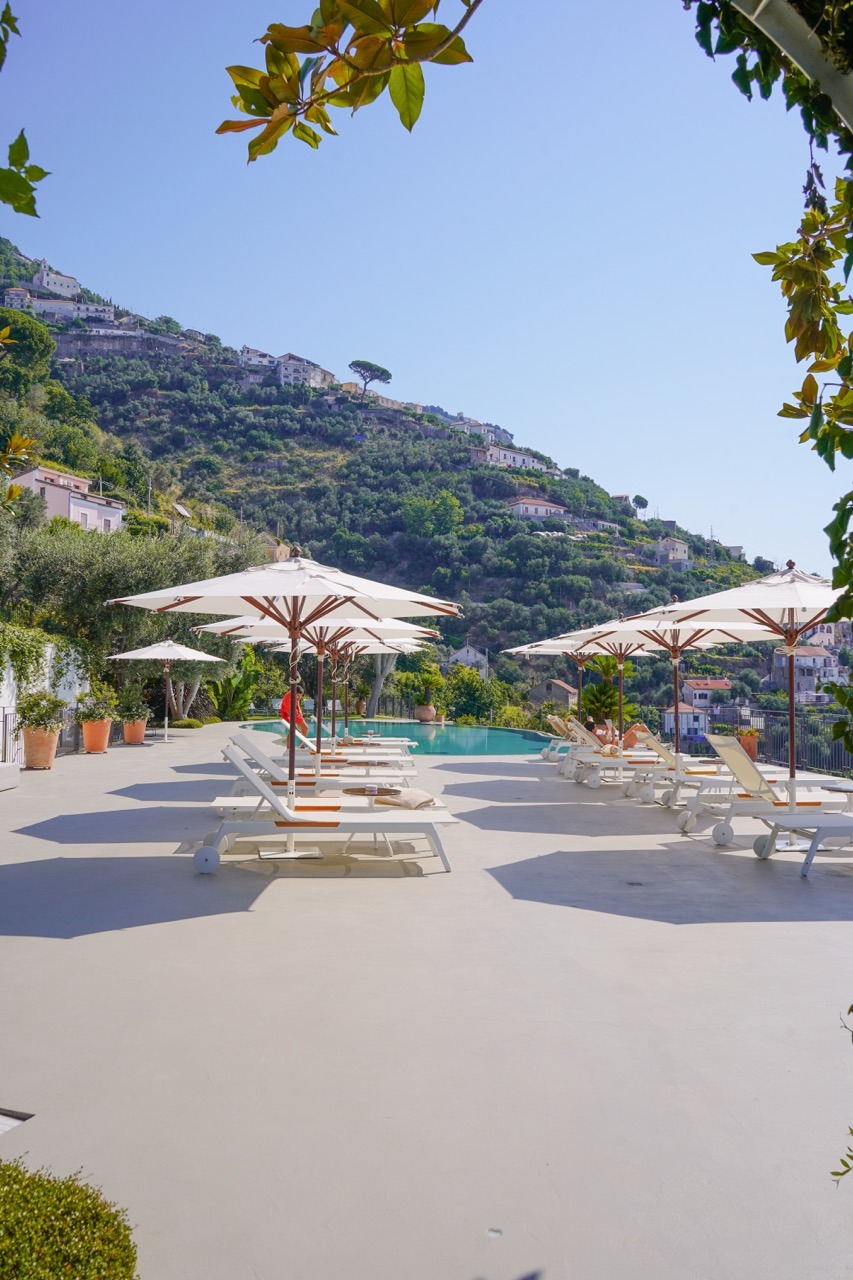
Furore Grand Hotel has two pools, both infinity pools whose edge lines up with the sea below, with the whole coast in view. Beside them are yoga decks and a gym facing the sea.
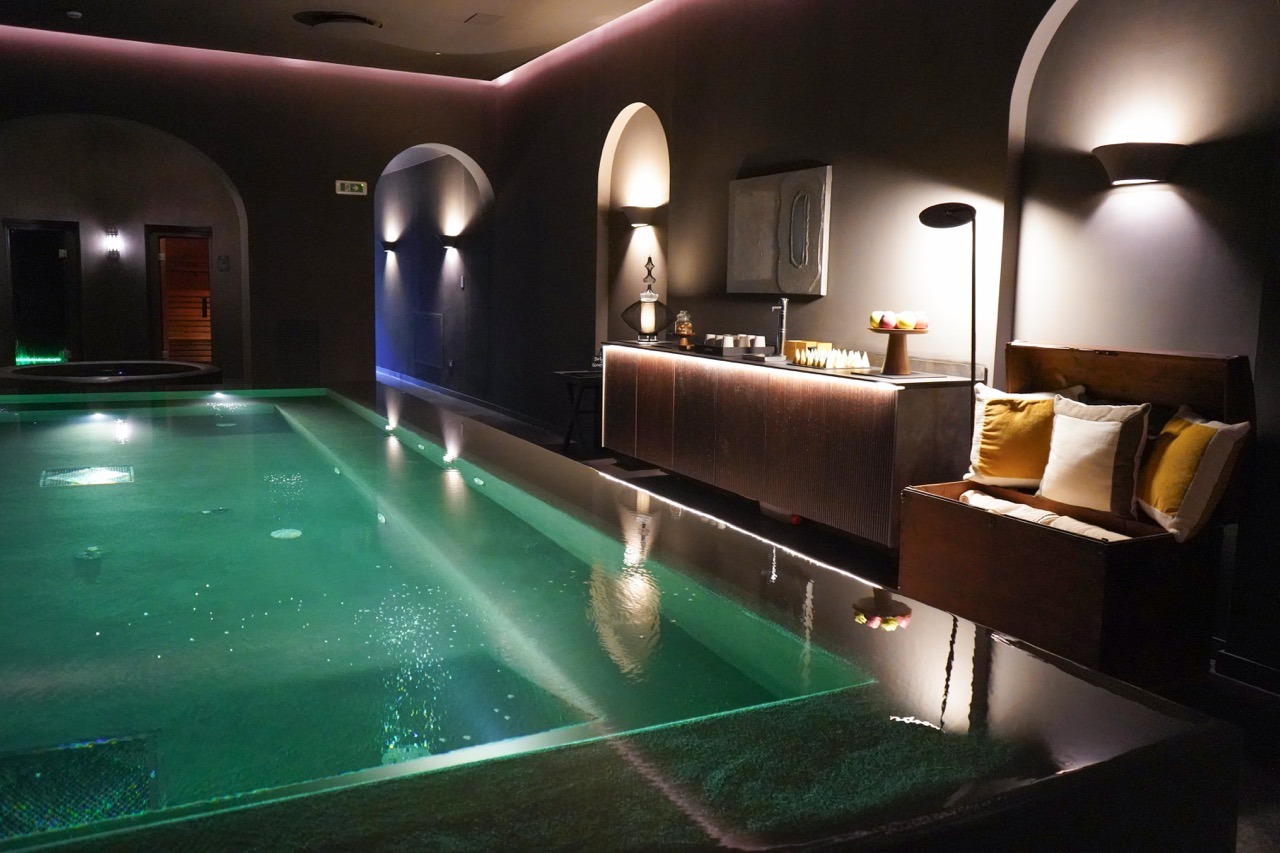
For time indoors, head to Petramare Spa, with heated pools, a sauna and a Turkish bath. Its theme is the olive, a symbol of long life on this coast. Olive goes into the treatments, and the spa has fragrances of its own, created only for Petramare and inspired by sun-warmed olive groves, herbs and sea air.
The Head Spa pairs scalp and body exfoliation with natural masks and slow, sensorial massage. In the Herbarium, a small atelier inside the spa, guests can choose and blend Mediterranean herbs with the team's guidance and take them home as a personal fragrance or cosmetic.
The village that isn't there
Furore lies between Positano and Amalfi, yet it has a feel all its own. Locals call it il paese che non c'è, the village that isn't there: there is no piazza by the sea, and its houses are scattered, one here, one there, up the mountainside from the coast road towards the Agerola plateau. Its old name, Terra Furoris, the land of fury, is said to come from the sea raging inside the fjord on stormy nights.
The village's history is bound up with Amalfi. From 839, Amalfi flourished as a maritime republic, one of the earliest in Italy. It grew rich on trade with the Eastern Mediterranean and even produced one of the oldest codes of maritime law. According to tradition, Furore was settled by Amalfitans sent away for political reasons. Here they made paper, silk, pasta and rope, and cut terraces into the steep slopes, where olives, vines and lemons still grow today.
There is a film connection, too. In 1948, Roberto Rossellini shot part of L'amore in the fjord, with Anna Magnani, then his partner, and a young Federico Fellini in the cast. The small fishermen's houses on the beach are still there.
See the fjord from the water
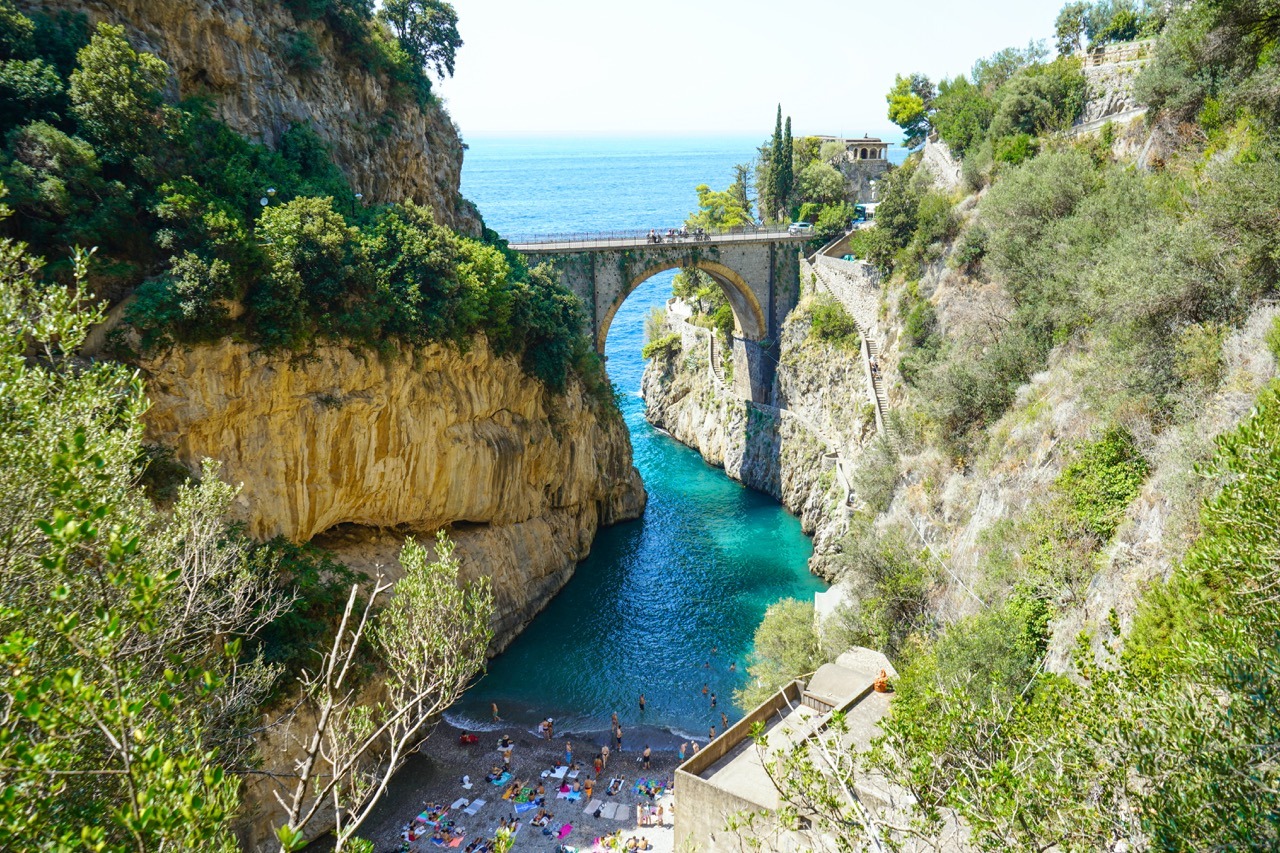
Mention the Fiordo di Furore and most people picture the same scene: a narrow cleft in the rock, a road bridge some 30 metres above the water, and a small pebble beach of about 25 metres below. It is one of the most photographed spots on the coast.
That also makes it very busy in high summer. Reaching the beach on foot means a long, steep descent on stone steps from the coast road, and the same climb back up. There is no parking nearby, and the sun leaves the beach early in the afternoon. Still, those who make the walk will notice something from the pebbles: boat after boat gliding into the fjord, pausing, and slipping out again.
In truth, the place is best seen from the sea. Marina di Praia, the small harbour next door in Praiano, is lined with gozzi, the wooden boats of this coast, and the usual way is to hire one privately, with a local skipper at the helm. A half day is enough to slip into the fjord from the sea, swim in a cove kept cool by the surrounding cliffs, and carry on along the coast to Conca dei Marini, the Emerald Grotto or Positano. Lunch can be on board, or ashore at one of the harbours along the way.
What stays with you
Pools above the sea, a Michelin-starred kitchen, a spa, a boat out to the fjord: everything you could want from a summer on the Amalfi Coast is here. But what made this trip special were the people who welcomed us.
A chef keeping an eye on every plate in the middle of a busy night. Easy conversations with the hotel's team, in the restaurant, by the pool, over breakfast on the terrace. They notice what you need before you say it, yet never hover: flawless professionalism, with a warmth that asks nothing of you.
In Italian, the word ospite means both host and guest. Here, hospitality has long been understood not as a service but as a relationship between people, and that, I think, is why this trip stays with me. However beautiful the view, however good the food, it is the care of the people who offer it that turns it into a memory.
Furore Grand Hotel