iichiko Saiten IRODORI Cocktail Competition 2026
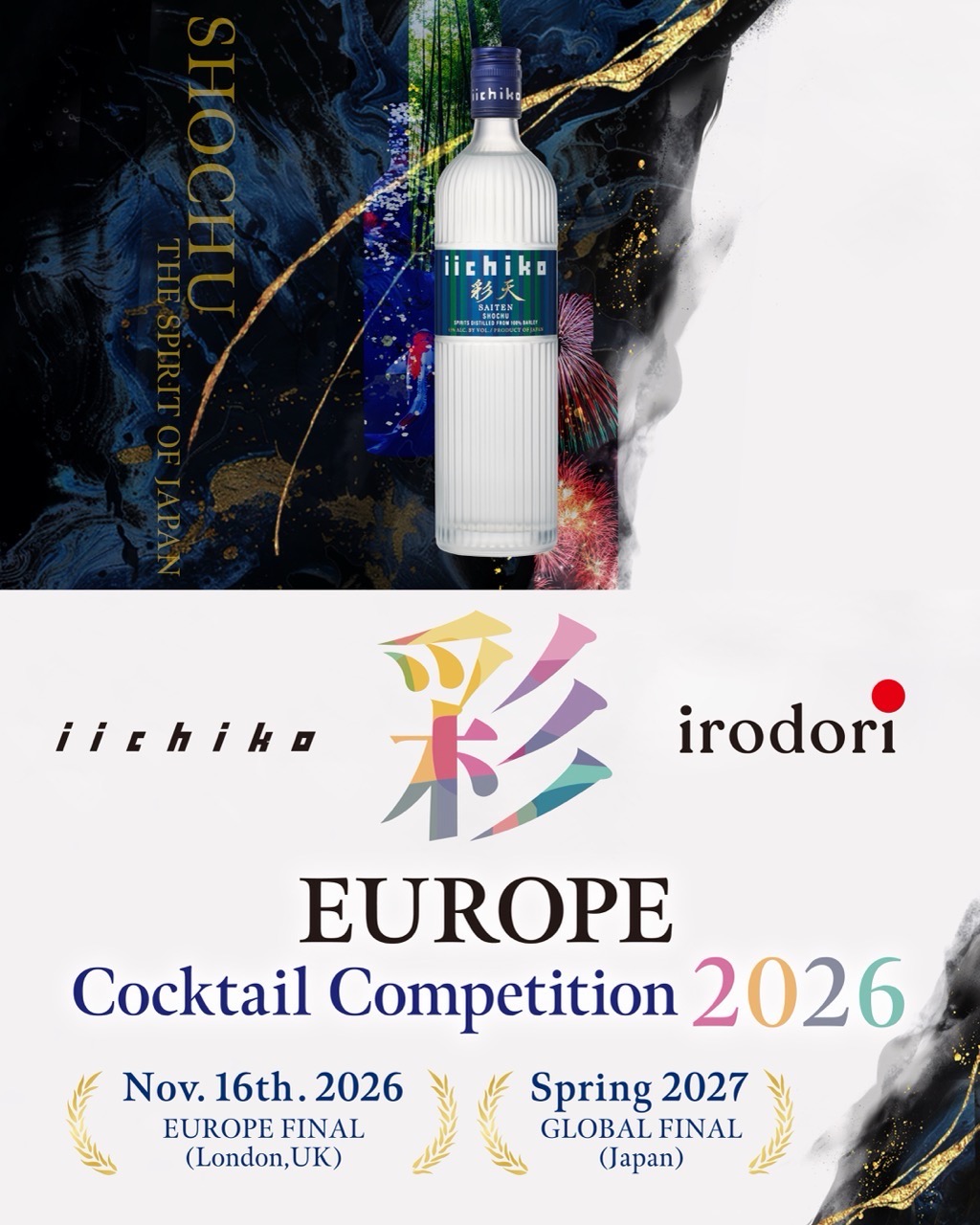
The European edition of the iichiko Saiten IRODORI Cocktail Competition is about to begin.
The competition has continued to grow, with previous editions held in the United States, Singapore, Hong Kong and Japan.
The first Japan competition alone attracted 275 bartenders. This year, Europe joins the competition for the first time.
Commenting on the expansion, Shoichi Oshiumi, Director of the Sales Division at Sanwa Shurui Co., Ltd., said,
“This year, we are launching a new competition in Europe, with the Global Final to follow. We hope each of you will fully express your individuality, your own ‘irodori’, or unique colour. We are truly looking forward to discovering the new possibilities that will come from your creativity.”
Applications close on 31 August.
If you’re thinking about entering, now is the time
→Apply for IRODORI Cocktail Competition Europe 2026
From the Online Briefing Held in Japan
The information below comes from the official online briefing held in Japan. The theme and core rules also apply to the European competition, so we’ve pulled together the points that may be useful if you’re considering entering.
2026 Competition Theme
This year’s theme is “IRODORI × KOJI × CULTURES”, with the idea “Your Culture, Color One Glass.”
At the centre of the theme is koji, a fermentation culture that plays an essential role in Japanese food.
The idea is to bring koji together with different cultures and perspectives from around the world and explore what that can become in a cocktail.
Just as Japan itself varies enormously from Hokkaido to Okinawa in climate, food, history, traditions and lifestyle, every bartender has their own culture too.
That could mean your background, values or roots, a place that has influenced you, a culture you respect, food, customs, music, travel or lifestyle. All of these can become part of your own “colour”.
One useful point from the briefing was just how broadly “culture” can be interpreted. It doesn’t have to mean traditional culture or where you were born. It can be something that has influenced you or something that genuinely matters to you.
The challenge is to take that culture and combine it with Japanese koji, then express the result as a story and flavour in one glass.
Different cultures might work in harmony or create contrast. Either way, the idea is to bring your own colour into the cocktail.
Eligibility
Applicants must submit an original recipe and be of legal drinking age in their country of residence at the time of application. They must also be at least 20 years old by the Global Final in spring 2027, as 20 is the legal drinking age in Japan.
Applicants must currently work as a bartender at a bar, hotel, restaurant, café or similar venue, or have equivalent professional bartending experience.
At the time of application, iichiko Saiten must be stocked on the back bar at the applicant’s place of work.
Applicants must not be working as an ambassador, sponsored partner or in a similar paid promotional role for another specific alcohol brand.
They must also be available for the Europe Final in London on 16 November. Round-trip travel and accommodation for the London Final will be covered by the organiser.
Entrants must also be able to attend the Global Final in Japan in spring 2027.
European Competition Schedule
Round 1 — Applications open from 1 July to 31 August. Results announced by 5 September.
Round 2 — Video submission round, from 5 September to 30 September. Results announced by 10 October.
Round 3 — Europe Final — 16 November in London.
Prizes
1st Place — GBP 1,200, plus round-trip travel to Japan for the Global Final, a visit to the iichiko distillery and a guest shift.
2nd Place — GBP 500
3rd Place — GBP 250
Cocktail Rules
The main rules are:
Follow the theme
Create an original cocktail based on “IRODORI × KOJI × CULTURES.”
Use iichiko Saiten
Every cocktail must contain at least 30 ml of iichiko Saiten.
Maximum six ingredients
Cocktails may contain up to six ingredients. Garnishes are generally treated separately, but if a garnish affects the taste or aroma of the drink, it counts as an ingredient. More examples are included below.
Edible garnishes only
All garnishes must be edible.
Additional Entry Requirements
There are also a couple of requirements relating to the entrant’s venue.
iichiko Saiten must be stocked on the back bar at the entrant’s place of work at the time of application.
Winners are also required to put their winning cocktail on the menu at their venue for the following menu period, or as a seasonal item for at least one month.
Recipes cannot be changed after submission
The recipe submitted for the first round must also be used for the second round and the final.
Recipes cannot be changed between rounds. You will compete with the same recipe you originally submitted throughout the competition.
Re-entry
You may submit a new entry for the first round if you wish to redo your application.
However, as this will result in multiple application forms being submitted, please email the competition organizers to let them know if you re-enter.
Judging
Entries are evaluated by several judges. Applicant information is not disclosed during judging, so the cocktails can be assessed independently of who created them.
The scoring is:
Flavour / Balance — 30 points
Originality / Creativity — 20 points
Understanding of the Theme — 20 points
Product Knowledge — 20 points
Replicability — 10 points
One point worth paying attention to here is replicability.
Judges will consider whether another person, using the same ingredients and instructions, could reproduce the same cocktail. If you’re planning to use homemade ingredients or more technical preparations, this is worth keeping in mind from the beginning.
Q&A: What Matters in This Year’s Theme?
“IRODORI × KOJI × CULTURES” is an important part of the judging.
The question is how you combine koji with something from your own culture and translate that into a cocktail.
That might come from your roots, a place that has influenced you, food culture, history, tradition, travel, music or your lifestyle.
The briefing made it clear that bartenders are free to interpret “culture” broadly, so there is plenty of room to approach the theme from your own perspective.
Ingredient Count: Some Specific Examples
A common question is whether garnishes count towards the six-ingredient limit.
Generally, garnishes are separate. But if the garnish affects the taste or aroma of the cocktail, it counts as one of the six ingredients.
The same rule applies to finishing sprays and powders. If they add flavour or aroma, they count.
It also doesn’t matter whether the garnish physically touches the liquid. What matters is whether it changes the taste or aroma of the finished drink. Anything placed on or around the rim of the glass also falls under the garnish rules.
There is no word limit for the written cocktail concept, so you can explain the idea, inspiration and thinking behind the drink in as much detail as you need.
Replicability
There are currently no special restrictions on homemade ingredients.
For example, if you make a homemade vermouth using white wine and three spices, the finished vermouth counts as one ingredient. The same applies to a homemade cordial made with sugar, fruit and spices.
Infusions using herbs or spices, steeping and other preparations are also permitted.
There are no specific restrictions on the brands or ingredients you can combine with iichiko Saiten, so products from other companies can be used.
The important point is whether someone else could make the same thing. Are the ingredients available? Can the method be followed and reproduced?
Specialist equipment such as rotary evaporators or centrifuges is not prohibited. But if the recipe depends on expensive or unusual equipment that most bars don’t have, that may affect the score for replicability.
It’s also worth being as detailed as possible when writing your recipe, particularly for homemade ingredients.
In previous competitions, some entrants made excellent homemade ingredients but didn’t explain them clearly enough for the judges to fully understand what they had done.
Include the ingredients, quantities, method and individual steps. It will make the recipe easier to understand and evaluate.
Language
The competition will be conducted in English.
Important Notes for the Entry Form
You will need to upload a photo of your cocktail.
Each image file must be no larger than 2 MB. If the file exceeds this limit, you may encounter an error or the organizers may not receive it properly.
Quantity Required for the European Final
At the European Final, you will be required to prepare five servings of your cocktail.
If your recipe includes any homemade ingredients, please keep this in mind and make sure you will be able to prepare enough for the final.
A Message from Sanwa Shurui
Sanwa Shurui’s aim is to help authentic shochu become a spirit enjoyed by people around the world.
But, as the company explained during the briefing, that isn’t something a producer can do alone. Bartenders are an essential part of it, because they work directly with guests and introduce people to new ways of enjoying spirits.
Through IRODORI, Sanwa Shurui is asking bartenders to put their own sensibility, culture, background and story into the glass.
The competition isn’t only about ranking cocktails. It is also part of a wider effort to build a new chapter for shochu and bartending culture together.
About iichiko Saiten
iichiko Saiten has three key features in its production: 100% barley koji, atmospheric-pressure distillation and vacuum distillation.
All-Koji Brewing
Koji is central to Japanese food culture and is used to make products including miso, soy sauce and sake. It plays an important role in developing umami and complex flavours.
Most standard iichiko products use both barley koji and steamed barley. iichiko Saiten, however, is made with 100% barley koji, using a method known as all-koji brewing.
This brings out more depth, richness and concentration from the koji.
Atmospheric and Vacuum Distillation
Authentic shochu, or honkaku shochu, is distilled in stainless-steel pot stills.
Two main methods are used: atmospheric-pressure distillation and vacuum distillation.
Atmospheric-pressure distillation takes place under normal atmospheric pressure and at higher temperatures. It tends to produce more roasted and toasty notes, along with body, a longer finish and a stronger character.
Vacuum distillation takes place in a depressurised still at lower temperatures, around 40–50°C. The result tends to be fresher, clearer and lighter.
The use of large-scale vacuum distillation equipment is also one of the more distinctive aspects of shochu production compared with many other spirits categories.
Why Stainless Steel?
There are two main reasons stainless steel is used.
First, vacuum distillation requires the inside of the still to reach a near-vacuum state. Copper is relatively soft, which makes it more difficult to use for large-scale equipment under these conditions.
The second reason is flavour. Stainless steel allows the character of the raw ingredients to come through without the still itself having as much influence on the final spirit.
Blending Two Distillates
For iichiko Saiten, the stronger character of the atmospheric-distilled spirit is brought forward first, then balanced with vacuum-distilled shochu.
This gives Saiten its rich, toasty character while keeping a long, clean finish.
The Meaning of “Saiten”
The name Saiten carries the meaning of “an authentic shochu that adds new colour to the world.”
It was developed with leading bartenders in the United States with the aim of creating a shochu that could work alongside other global spirits.
iichiko Saiten was first launched in the US in 2019. At 43% ABV, it was developed specifically with bartenders and cocktails in mind.
Tasting Notes
iichiko Saiten has a toasty character from the barley koji, with caramel-like notes, a rich body and a long finish.
Other notes mentioned in the briefing included jasmine tea, white peach, minerality, citrus and salinity.
Its flavour chart also includes chocolate, raisin, rose, banana, ripe strawberry and honey, while the aroma profile includes chocolate, cream and rich barley.
More about iichiko Saiten
A Spirit Built for “Mixing”
iichiko Saiten started with a straightforward idea: to make shochu a spirit that could be used in bars around the world. It was developed with leading bartenders in the United States and launched there in 2019, before later coming back to Japan. One of the ideas behind its development came from the different ways people talk about mixing drinks in Japan and the US.
In Japan, shochu is commonly mixed with water, soda or tea. In Japanese, we use the verb waru — literally, “to divide”. During the briefing, this was compared to division. If something has a value of 10 and you divide it by two, you get 5. The original element becomes lighter.
In American bars, the word is “mix”. The briefing compared this instead to multiplication: take something worth 10, combine it with something else worth 10, and create something worth 100.
The point isn’t that one approach is better than the other. It’s a way of looking at the role of ingredients in a cocktail: different elements are brought together to create something new.
iichiko Saiten was developed with that idea in mind.
A base spirit needs enough character to remain present when it is mixed with other strong ingredients. This is one reason Saiten is bottled at 43% ABV, considerably higher than conventional shochu, with a flavour profile designed to stand up in cocktails.
That idea of combining different elements to create something new also connects naturally with this year’s theme: bringing your own culture together with koji in a single glass.
It may be a useful starting point when developing your entry.
Apply here
→IRODORI Cocktail Competition Europe 2026
Sanwa Shurui







square.jpg)